


New:
Compromise reached in Senate to improve testing bill
 Flores’ bill regarding state assessment requirements has several amendments that improve the bill. The bill now includes several of Senator Montford’s bill to reduce testing in schools. The bill:
N. Y. Times: Who Needs Charters When You Have Schools Like This!
 Ask children, teachers, and parents about time. They will likely say: “There’s not enough time in a day to do what needs to be done”. There are ways to do something about it. We in Alachua County have been talking about how to reorganize the day to fit in pre school, hands on academic programs, school activities, and after school activities in a semi rational way. We are asking if it is possible, without large influxes of money, to make an 8-5 school day. Could all of these activities happen in one place without driving teachers to distraction?? Our local league will study examples of how this could be done.
Professor David Kirp, University of California, Berkeley, already has some successful examples. In Tulsa, Oklahoma the Union school district has implemented a community-based school program that has defied the demographic odds. School attendance has soared, achievement has risen, and suspensions have plummeted. We need schools like that here.
We have one school, Howard Bishop, that has been identified as a community school. It is just starting in that direction this year, and has not expanded to the full eight hour day. The community social services support, however, are centered not in various offices in town, but in the school. They have a ways to go to catch up with the Union school district, but the Children’s Home Society is helping them.
We all need to help community schools make progress. If nothing else, you can help financially. It is not all about money, though. Oklahoma has lower per student funding than Florida, and this district has found a way to expand the day and still make ends meet. Let’s find out how.
With community support we can begin to dream of a world where the lack of time does not manage us; we manage time! Let’s see if we can make our public schools the envy of the world of choice.
It’s Take Over Time

Legislation
It’s that time in the legislative session. The proposed budgets are out. The bargaining begins. The Florida House wants money for charter schools. The Senate wants money for public schools.
Many legislators want money to expand tuition payments to private, mostly religious schools. HB 15 adds children of military families to the tax credit voucher program. The per student increases from 80 to 88% of the FEFP public school amount for elementary students. Middle school funding increases to 92% and high school to 96% of FEFP. The pretense that the Florida tax credit scholarship program saves money is gone. Corporate taxes that could help Floridians go to private schools that have little accountability and uncertified teachers.
Charter school bills feature getting a share of local property taxes for facilities, taking over struggling public schools, and creating a separate charter school system. In addition, they allow uncertified teachers in charters and require public school facilities be given to charters. There is more.
Retain Students or Do not Retain?
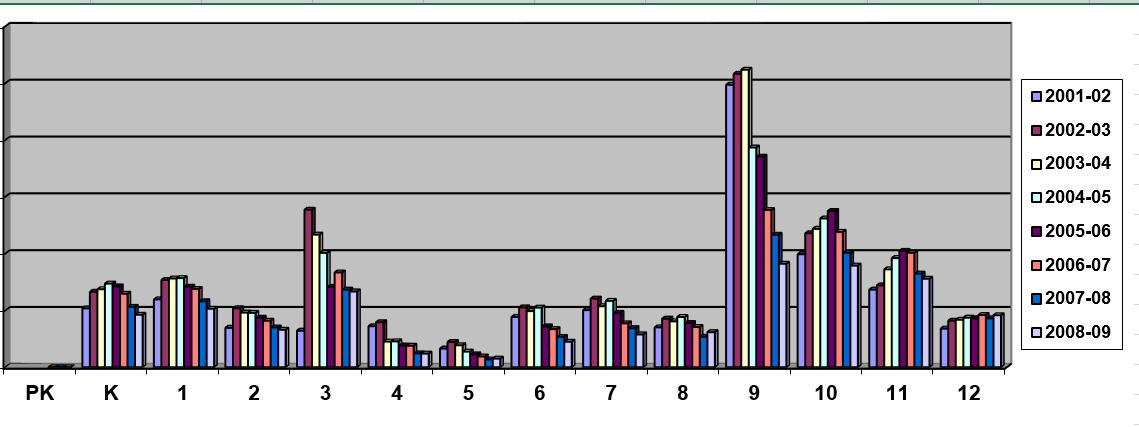
A lot of hoopla has been centered around third grade retention based on Florida assessment scores. It was credited for the large increase in Florida’s fourth grade reading scores. Something went wrong, however, in eighth grade. What went ‘wrong’ may have nothing to do with the quality of instruction. If so, what could explain the apparent decrease in eighth grade achievement? Some possibilities are suggested.
The case for retention. Retention became mandatory for third grade in 2002-03. Florida, however, retains students beginning in kindergarten as the above chart shows. Thirteen percent of third graders were retained. An additional nine percent of the lowest scoring students were promoted with a ‘good cause exemption’ such as a portfolio, an approved alternative test or consideration of a type of disability, and certain English language proficiency rules.
Retention helped (58%) some students according to a 2006 Office of Program Policy Analysis and Government Accountability (OPPAGA) study. It certainly boosted the image of the ‘Florida miracle’ of achievement increase. In spite of the publicity about school reform measures, however, the chart below shows the greatest improvement occurred between 1998 and 2002, before reforms and mandatory retention were implemented. Florida went from below the national average in fourth grade reading and math scores to above the national average. Some gains continued afterward.

Changes in retention policy. Over the years, retention has diminished because more exemptions were granted. (Some students were simply getting too old for the grade in which they were enrolled.) In 2014-15, the Florida Department of Education granted exemptions to 28,436 third grade students.
Note below the significant decrease in non promotions in 2014-15, in spite of enrollment increases, especially for third and ninth grade.
Retentions: 2002-03 2014-15
Kindergarten: 13,278 7,674
First Grade: 15,360 8,250
Third Grade: 27,713 9,458
Ninth Grade: 51,638 9,870
As of 2011-12, only fourteen states mandated third grade retention. Florida’s high retention rates compared to other states no doubt helped boost its fourth grade National Assessment of Education Progress (N.A.E.P.) scores in earlier years, but there may be more to that story.
Questions about the value of retention. When results are not clear, opposition grows. HB 131 Cortes (SB 1280 Rodriquez) have been filed to end third grade retention.
The big puzzle now perplexing the legislature, Senator Stargel SB 360 in particular, is why Florida’s fourth grade NAEP reading scores are six points higher than the national average, but eighth grade scores are just average. Fourth grade math scores are higher than average, but eighth grade math scores are consistently lower. Stargel proposes a study to find the answer. A look at the NAEP data gives some clues:
In fourth grade, 39% of students score at or above the NAEP reading proficiency level. Only thirty percent do so in eighth grade. These are the top scoring students.
One would expect that the percentage of high scoring students would be relatively the same for fourth and eighth grades unless, in some way, students’ characteristics change from elementary to middle school. What could account for the difference?
Do Florida students’ reading skills get worse over time? This seems unlikely. There was a relatively large increase in reading scores for eighth grade in 2009, and scores have only fluctuated slightly since then.
Other possible explanations. Perhaps eighth grade student characteristics are now different than in fourth grade? How could this be? There are several ways to explore this possibility:
- Florida’s retention policy is more extreme than most other states’ policies. Thus, Florida has more students who have been in school longer by fourth grade than do other states. One would expect their reading and math levels to be higher. This advantage may be lost by eighth grade when these skills are more complex.
- Does Florida’s school choice policy pull out more low scoring students in elementary grades, thereby elevating its fourth grade scores compared to other states? Do many of these students return to public schools in middle school and lower the state achievement scores?
We know from Florida DOE data that the Florida tax credit program enrollment drops more than one half between kindergarten and eighth grade. Which students leave the private schools and which remain? If the struggling students leave, as the DOE evaluations suggest, eighth grade scores in public schools would decline.
A similar examination of the achievement levels of students who return to public schools from charter schools between fourth and eighth grade may also shed some light on the changing student achievement
I welcome an evaluation of Florida’s school accountability approach to improving student learning.
Warning: Array to string conversion in /home/lwveducation/public_html/wp-includes/formatting.php on line 1128


-

- League Members visit the office of Senator Marco Rubio
-

- League Members wait to see Senator Bill Nelson

-

- Education Team at the Department of Education
Pingback: Newly Surfaced Video of Moms for Liberty Advisor Reveals Religious Extremist Agenda - Bucks County Beacon